Dry heat and humid heat need slightly different things
Pakistan doesn't have one summer. It has at least two, and the trouser that suits one city isn't always ideal in the other.
- Dry heat in Punjab, Sindh's interior and much of Balochistan: from May to July the sun is the main problem. A cloth that shades your skin and lets air through matters more than anything else, and a paler colour really helps outdoors.
- Humid heat in Karachi, the coast, and everywhere during the monsoon: sweat stops evaporating easily. Here a loose fit and a light weave matter most, so that air can reach your skin and the cloth doesn't cling.
- Motorbike riders: the sun sits on your thighs for the whole ride, and the seat traps heat behind you. A tight or dark trouser is at its worst here.
- Office workers: you may move between a 42 degree car park and a cold AC room all day. A medium-light cotton copes with both better than a very thin one. Our office trousers guide covers which dress codes an elastic waist suits.
Fabric: why the fibre comes first
Cotton takes sweat into the fibre and lets it go as vapour, and it doesn't feel slick or sticky against damp skin. Polyester absorbs almost nothing, so the sweat stays on you. That is why a polyester or poly-viscose trouser can feel cool and smooth in the shop and clammy by noon. Our guide to telling real cotton from polyester shows how to read the label and test the cloth at home, because "cotton feel" and "cotton rich" on a tag don't mean 100% cotton.
Linen is the other good summer fibre. It's very airy and dries fast, which makes it pleasant in Karachi's humidity. The trade-offs are that it creases hard within minutes of sitting down, and real linen costs more; much of what's sold as linen in local markets is a blend, so check the label. Viscose and rayon feel soft and cool at first, but they tend to cling once damp, and most of what's on sale here is blended with polyester anyway. For most men, day in and day out, 100% cotton is the sensible default.
Weave and weight: not all cotton is cool
A trouser can be 100% cotton and still be hot. Heavy denim and thick drill are cotton too, and they are miserable in June. What you want is a light to medium woven cloth with a little openness to it.
Try this in the shop or the moment your parcel arrives: hold one layer of the cloth up to a window. If some light comes through the weave, air will too. If it blocks the light completely, it will feel warmer on the leg. A seller who lists the fabric weight helps you further: for woven summer trousers, roughly 200 GSM or under is a useful guide, though the weave matters as much as the number. Don't go so thin that it turns see-through in a pale colour, or that it wears through at the seat in one season.
Fit: loose beats everything except the fabric itself
Air has to move between the cloth and your skin for sweat to evaporate. A slim or skinny trouser stops that where it matters most, at the thigh, the seat and the waistband. Those are also the places where damp cloth rubs, so that's where chafing starts.
Look for room through the thigh and a waist that doesn't dig in. An elastic waist with no belt helps more than people expect, because a leather belt adds a hot, tight band right where you sweat most. If you're between two sizes in summer, the larger one is usually the better choice. Our trouser size chart gives waist and length in inches, so you can check against a pair you already own.
Colour: lighter helps in the sun, but only after the fabric
Pale shades reflect more of the sun, so sand, stone and sage feel cooler than black or navy when you're outdoors. It's a real difference, but a smaller one than the fibre: a pale polyester trouser will still feel hotter than a dark cotton one. Indoors or after sunset, colour barely matters, so don't give up a navy pair you like for evening wear.
Lighter colours show dust and stains faster, and that matters on a bike or in a dusty city. A mid-tone such as olive or khaki is a fair compromise. For what to wear on top, see our shirt and trouser colour combinations.
What to avoid in the heat
Most of these come down to the same thing: they stop air reaching your skin.
- Polyester and poly-viscose "formal" trousers, unless a dress code leaves you no choice.
- Stretch blends with elastane or spandex in a slim cut. That stretch usually comes with polyester, and the cut grips your leg.
- Heavy denim, for all its popularity. It's slow to dry and holds heat through the afternoon.
- Fleece-lined or terry trousers, which are built to hold warm air against your legs. They're for winter, and we say that even though we sell one.
- A pair still damp from yesterday. Keep two or three in rotation in peak summer, so each one dries properly between wears.
Is a trouser even the right answer?
Not always, and it's worth saying so. A loose cotton or lawn shalwar is hard to beat for pure airflow in the worst weeks, and plenty of men wear one at home for that reason. At home or on a weekend, three-quarter shorts are cooler still. A trouser earns its place when you need to look put together at work, at the market or out with family, and still get through a hot day comfortably.
Where Desire Cotton's Everyday Trouser fits
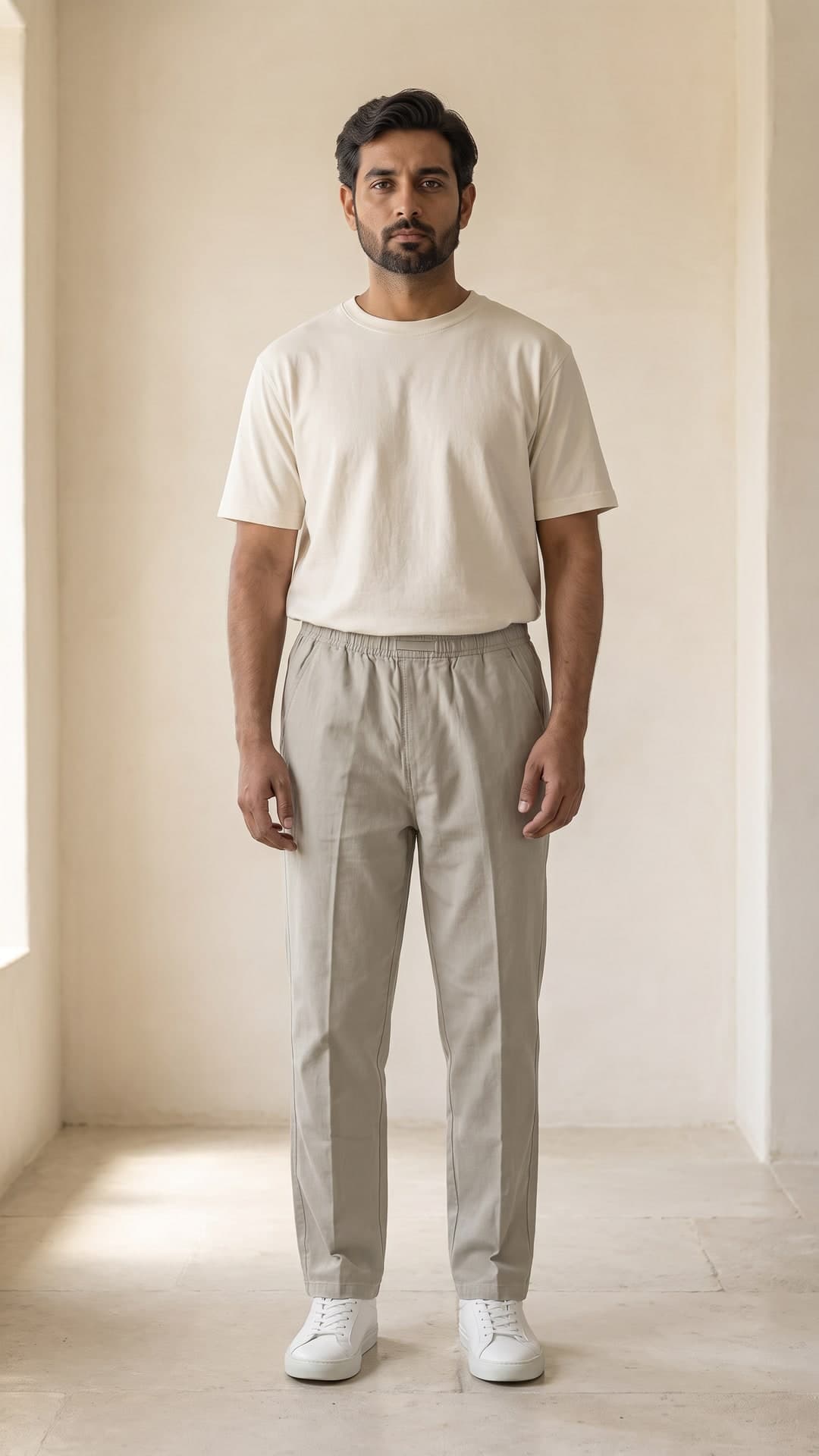
The Everyday Trouser is what we make for this. It's 100% garment-washed paper cotton: light and crisp, with no polyester in it. It has a comfort elastic waist and no belt, it's true to size, and it comes in eleven colours, in sizes S to 4XL, though stocked sizes vary by colour. The paler shades, such as Sand, Stone Beige and Sage Mist, are the ones to pick for strong sun. It costs Rs 2,999, with Rs 500 off when you buy two, free home delivery in 2 to 4 working days, and cash on delivery anywhere in Pakistan.
To be honest about the limits: it's a smart-casual trouser, not a formal one, and paper cotton has a natural crinkle, so it won't hold a sharp crease the way a polyester dress pair does. A light press flattens it in seconds. To keep the fit and colour, see how to wash cotton trousers.
If heat rash or prickly heat is your main reason for reading this, breathable cotton helps prevent the damp, overheated skin where it starts. Our guide to cotton for sensitive skin goes into more detail. A trouser is everyday clothing, not a medical treatment, so see a dermatologist if a rash persists or keeps coming back.